
Marble Fireplace Surround: Stone Choice, Heat Behaviour, Slab Plan and Safety
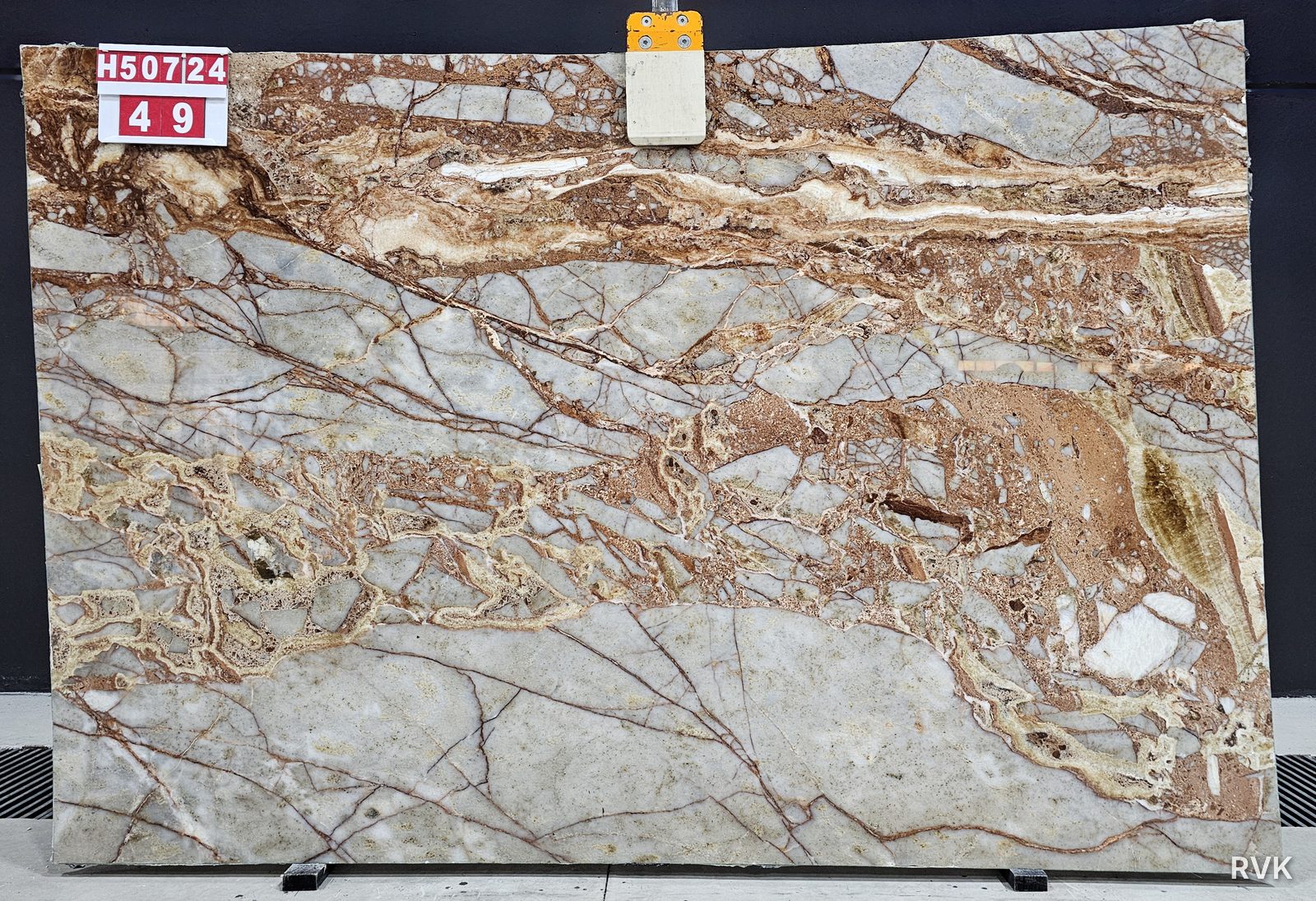
Onice Grande model, a breccia slab with a grey-blue ground and brown veins. On a fireplace wall a single slab creates a strong focal point.
A marble fireplace surround is planned around two questions: how the stone will look, and how it will respond to heat. Marble does not burn, but it conducts heat. The Natural Stone Institute's technical bulletin lists thermal conductivity values for marble between about 2.1 and 2.9 W/m·K and notes that heat transfer matters at fireplace surrounds (NSI). When the stone choice, the fireplace manufacturer's clearances and the slab layout are solved together, the marble wall becomes a lasting focal point of the room.
RVK Mobilya Dekorasyon is an Istanbul-based supplier of marble and natural stone slabs, offered as blocks, slabs and cut-to-size pieces. Production management and quality control are carried out in Istanbul, Türkiye. See the models and finishes on the marble slabs page. RVK also supplies bespoke furniture for the same interior, so stone and furniture can be coordinated.
Choosing the marble for a fireplace wall
In a small room, a calm, finely veined stone gives unity. On a large wall, a bold veined slab or a pair of bookmatched slabs gives a strong visual statement. White and grey stones suit modern living rooms, beige and brown tones suit wood-rich interiors, and breccia or dark stones suit projects that need contrast.
- Modern fireplace marble: Calacatta Oro, Calacatta Celeste or Fantasy White, set against a black metal firebox frame.
- Warm living rooms: Monaco Brown, King Perla or Bella Cream, with walnut or oak furniture.
- Accent wall: Onice Grande breccia or Silver Onyx, one slab with few joints.
- Grey and calm: Mjolnir Grey, Deep River fine-vein selection or Elsa Grey.
A commercial model name does not show how the veins will look, and every slab is different. For fireplace walls, request numbered slab photos and approve the cut plan on those photos.
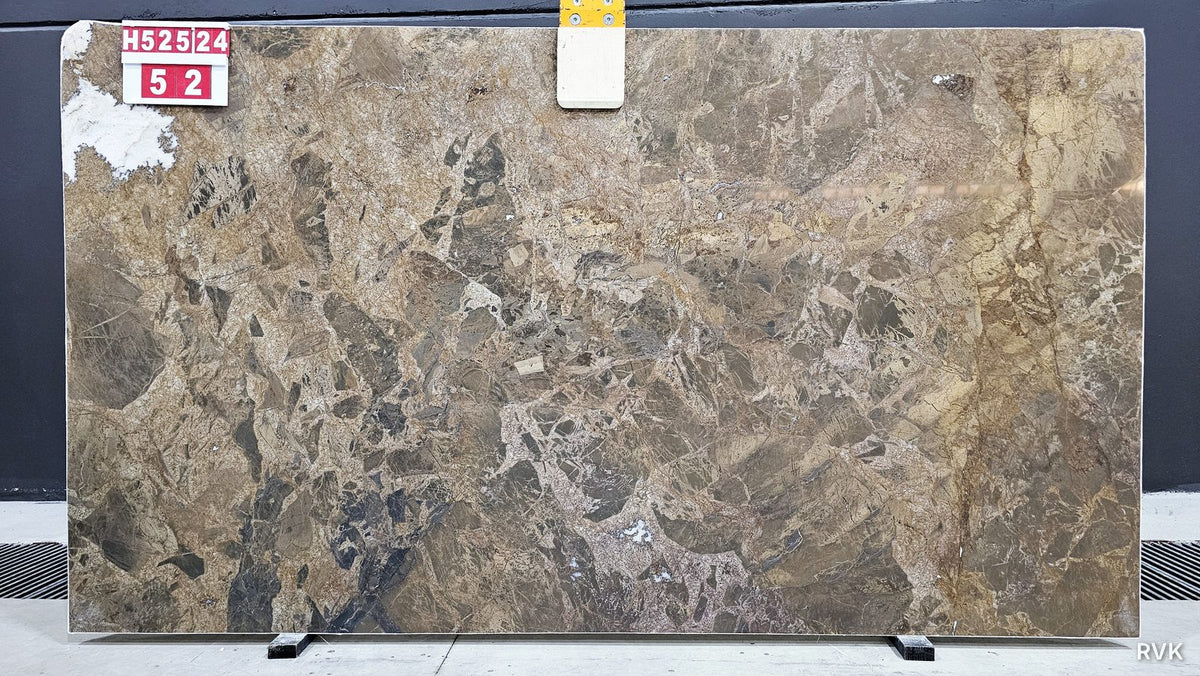
Monaco Brown model with a polished surface. For living rooms with wood furniture, it offers a warm option for the fireplace surround.
How marble responds to heat
Marble is calcium carbonate (GSA) and is not combustible. Because it conducts heat, the fireplace manufacturer's insulation and clearances protect the combustible structure behind the stone. The stone cladding itself is not a heat shield. Repeated heating and cooling is a second concern. In a laboratory, marble specimens exposed to thermal cycles showed micro-cracking and loss of strength, regardless of texture (Siegesmund et al., 2000). On building facades, daily and seasonal temperature swings were shown to drive damage (Tschegg and Kreč, 2010).
A fireplace surround does not see facade temperature cycles, but the principle is the same. Keep the stone away from direct flame and high surface temperatures. The firebox lining is built from refractory material, while the marble stays on the outer cladding.
Wood, gas, bioethanol or electric: which clearance?
| Fireplace type | Heat load | What to check for marble |
|---|---|---|
| Wood-burning | High, variable | Follow the manufacturer's distances; a honed finish hides soot marks well |
| Gas (sealed firebox) | Medium, steady | Glass edges and the top header are the hottest zones; follow the manufacturer's cladding diagram |
| Bioethanol | Medium | Open flame; keep the manufacturer's distance around the burner, and never let the stone touch the flame |
| Electric | Low | Decorative cladding only; widest freedom in stone choice |
Clearances and cladding rules are set in the fireplace manual and in local building regulations. This guide helps with stone selection. The safety decision belongs to the fireplace manufacturer's instructions and the qualified installer. No marble slab is considered safe simply because of its thickness.
Slab size, cut plan and joints
A fireplace wall is easier to cut when the plan is measured first. Confirm these details before ordering:
- The width and height of the firebox or appliance opening.
- The size of the side panels, the header and the hearth, if there is one.
- The total wall height. For full-height cladding, plan the slab length and the horizontal joint.
- External corner details: a 45-degree mitre, or a thicker edge built up with a bonded strip.
- Sockets, cable runs, ventilation grilles and other openings.
- Vein direction, and whether two slabs will be bookmatched.
Typical slab size is about 240 to 320 by 140 to 200 cm, depending on the model, so a wall up to about 3 metres high can be covered with one slab. Wider walls use consecutive numbered slabs, opened like a book. Fixing to the wall, by adhesive or mechanical support, depends on the substrate and the slab weight, and is decided by the installation team.
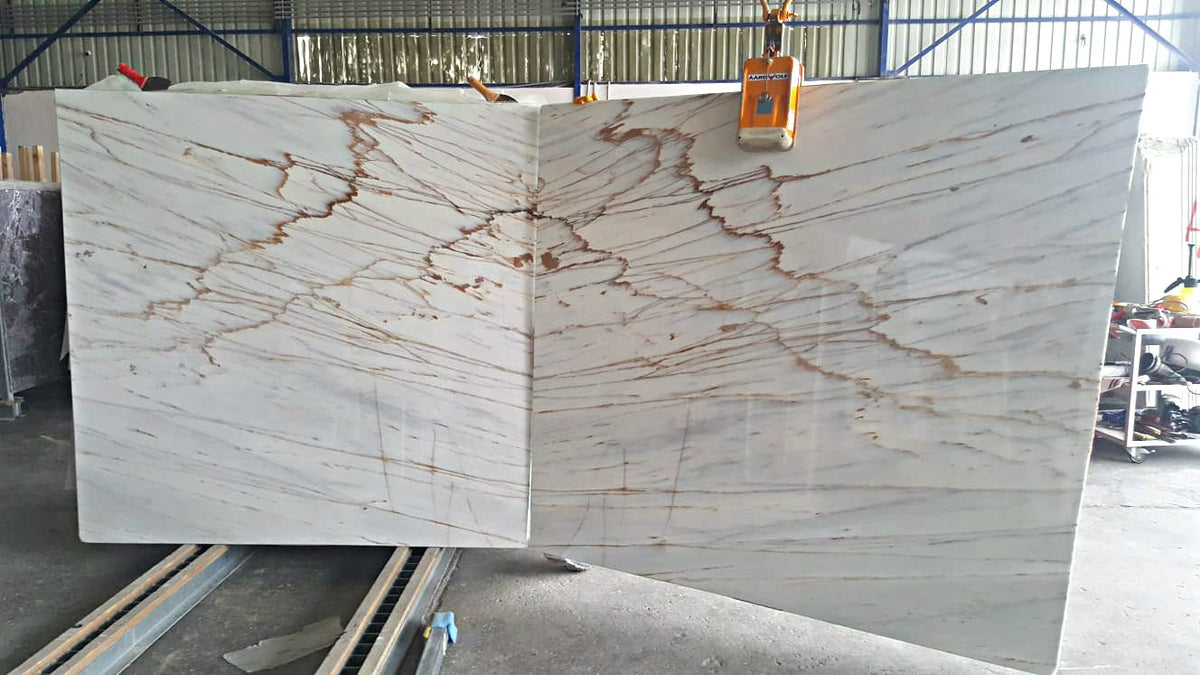
Two bookmatched Calacatta Gold type slabs. On a fireplace wall, symmetrical veining centres the room around the appliance.
Polished or honed for a fireplace surround
A polished surface reflects firelight and deepens the veining. A honed surface stays matt and hides soot and fingerprints. Surface roughness changes the gloss and the perceived colour of the stone (Careddu and Aru, 2023). Honed or brushed surfaces are common for wood-burning fireplaces because of cleaning, while polished surfaces are common for gas and electric models. Surface finish does not change how the stone responds to heat.
Marble or another stone?
Travertine, limestone and quartzite are also used around fireplaces. Travertine suits rustic rooms with its porous texture, and quartzite suits heavy use because of its hardness. Marble's advantage is the variety of veining and the large slab size. A buyer's guide to Turkish stones compares which stone suits which use, read our export buyers' guide. For interior applications, see the interior marble guide.
How RVK supplies marble for fireplace projects
Supply starts with slab selection. A block is matched to the colour and vein structure the project needs, then slabs are cut, polished and bundled. The buyer approves each numbered slab from photos, and video is available on request. Approved slabs are crated in ISPM 15 heat-treated wooden crates with padding and steel strapping.
Slab thickness is 2 cm as standard, with 3 cm on request. Slab-based prices range from USD 195 to 650 per m², EXW Türkiye, and quotes are valid for 10 days. Stock is dispatched within a few days of approval, while new cutting takes 3 to 4 weeks plus transit. A deposit is due at order confirmation and the balance is paid by bank transfer after photos or video of the crated slabs are shared and before loading. EXW, FOB, CIF and DDP to Europe are offered. Test reports from an accredited laboratory are available, and their scope depends on the model.
Conclusion
A marble fireplace surround is planned around the look of the stone and its response to heat. Marble conducts heat and does not burn, so the manufacturer's clearances and a refractory firebox protect the room. A numbered slab approval and a measured cut plan give a wall that is correct the first time.
Frequently asked questions
Can marble be used around a fireplace?
Yes, marble is used as an outer cladding. The firebox lining is refractory, and the fireplace manufacturer's clearances must be followed. The safety decision belongs to the manufacturer's instructions and the installer.
Does marble crack from heat?
Direct flame and repeated high temperatures can cause micro-cracking in calcite crystals (Siegesmund et al., 2000). A fireplace built to the manufacturer's clearances keeps the stone away from those temperatures.
Which marble colour suits a fireplace?
Wood-burning fireplaces make soot visible, so honed and medium to dark tones are easier to keep clean. Gas and electric fireplaces allow white and light veined stones. The choice depends on wall size, light and furniture.
Can a fireplace surround be covered with one slab?
Most living rooms can be covered with one slab, because a typical slab is about 240 to 320 cm long. For taller walls, the horizontal joint is placed at the height of the header.
Request a marble slab quote for your fireplace
Send the fireplace opening, the wall dimensions, the fireplace type, your preferred model and destination country. Numbered slab photos and a quote follow shortly.
Message us on WhatsApp Send an emailRVK Mobilya Dekorasyon · Kartaltepe Mah. Talat Artemel Sok. No: 2/2 Bakırköy, Istanbul, Turkey · +90 535 230 24 62 · info@rvkmobilya.com
Sources
- Natural Stone Institute (NSI) (n.d.). What Natural Stone is Best for Heated Surfaces: R-Value for Natural Stone (Technical Bulletin). naturalstoneinstitute.org
- Siegesmund, S., Ullemeyer, K., Weiss, T., Tschegg, E.K. (2000). Physical weathering of marbles caused by anisotropic thermal expansion. International Journal of Earth Sciences, 89(1), 170-182. DOI: 10.1007/s005310050324
- Tschegg, E.K., Kreč, K. (2010). Nondeformability of Ventilated and Mortar-Embedded Marble Facade Panels. Journal of Performance of Constructed Facilities, 24(1), 19-30. DOI: 10.1061/(ASCE)CF.1943-5509.0000063
- U.S. General Services Administration (n.d.). Marble: Characteristics, Uses and Problems. gsa.gov
- Careddu, N., Aru, W. (2023). Chromaticism differentiations: how variegated homogeneous stones used in buildings can gain diversified aesthetic appeal. Journal of Building Engineering, 63, 105452. DOI: 10.1016/j.jobe.2022.105452