
Marble Table Tops for Dining, Coffee and Console Tables: Slab, Weight, Support and Edge
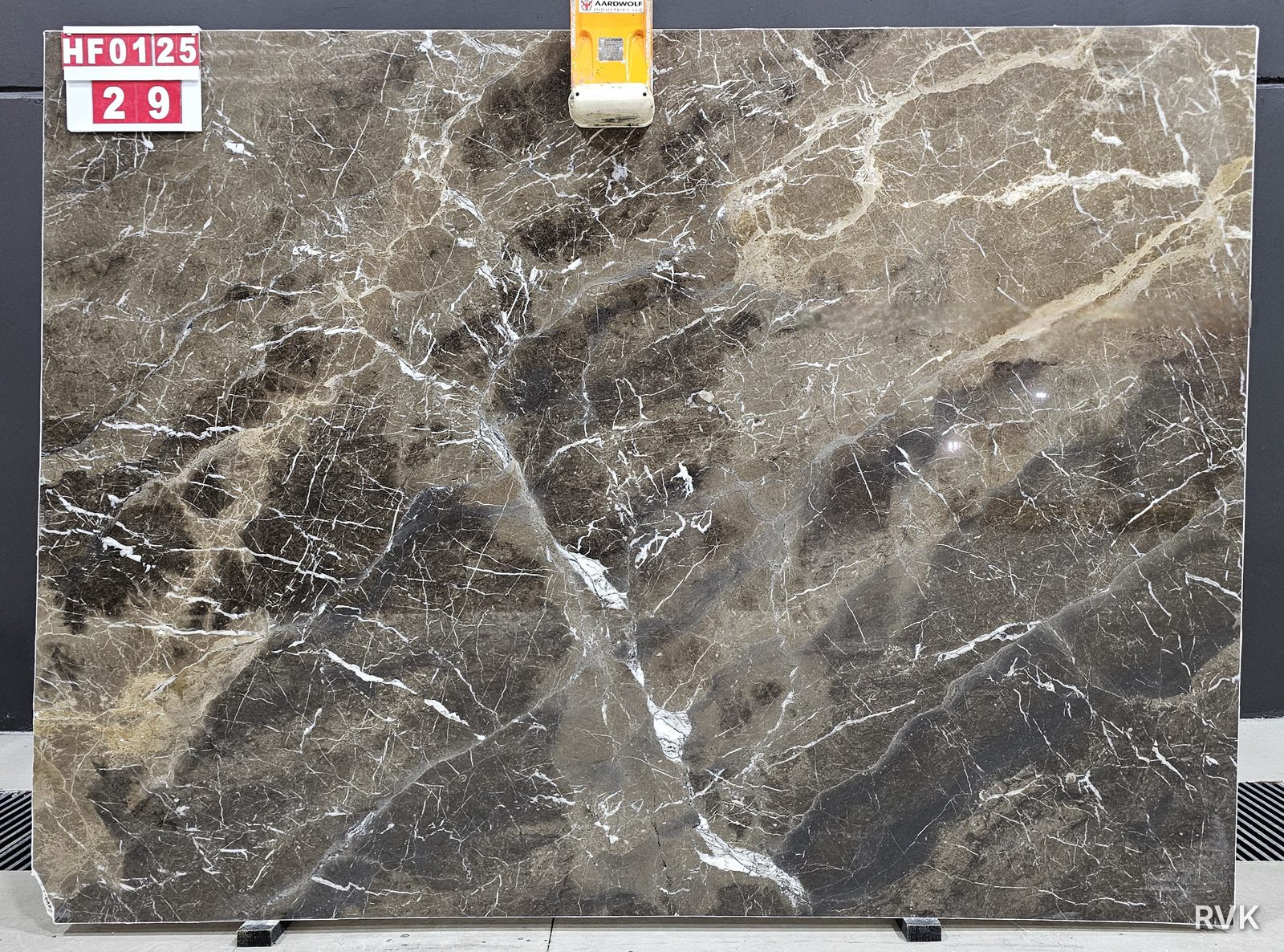
King Perla model, a polished brown slab. Dining and console tops are cut from one slab to keep the veining continuous.
A marble table top needs both an attractive stone and a sound structure. Calcite has a density of about 2.71 g/cm³ (Anthony et al., 2005), so a 2 cm marble slab weighs roughly 54 kg per m², and a 3 cm slab about 81 kg per m². Natural stone is brittle and its tensile strength is far below its compressive strength (Sorrentino et al., 2018), so the base under the top matters as much as the stone.
RVK Mobilya Dekorasyon is an Istanbul-based supplier of marble and natural stone slabs, offered as blocks, slabs and cut-to-size pieces. Production management and quality control are carried out in Istanbul, Türkiye. See the models on the marble slabs page. RVK also supplies bespoke furniture, so tops and furniture can be planned together.
Which marble suits which table?
A dining table meets food and drinks. A coffee table meets glasses and decorative objects. A console top meets perfume and keys. The stone is chosen for that use:
- Dining table: a honed surface or dolomitic whites such as White Dolomite. Fine-veined Kemalpaşa White or grey Elsa Grey also work well.
- Coffee and side tables: Calacatta Oro, Calacatta Amber or Onice Grande breccia, where a small surface can carry a strong vein.
- Console and TV unit: warm tones such as Monaco Brown, King Perla or Bella Cream sit well with timber bodies.
- Hotel and restaurant tables: consecutive slabs from one block and grade A selection keep many tops consistent.
Brittle stones such as breccia and onyx are supplied with mesh backing and an epoxy-filled face. Under a table top, they should always be bonded to a full-surface substrate.
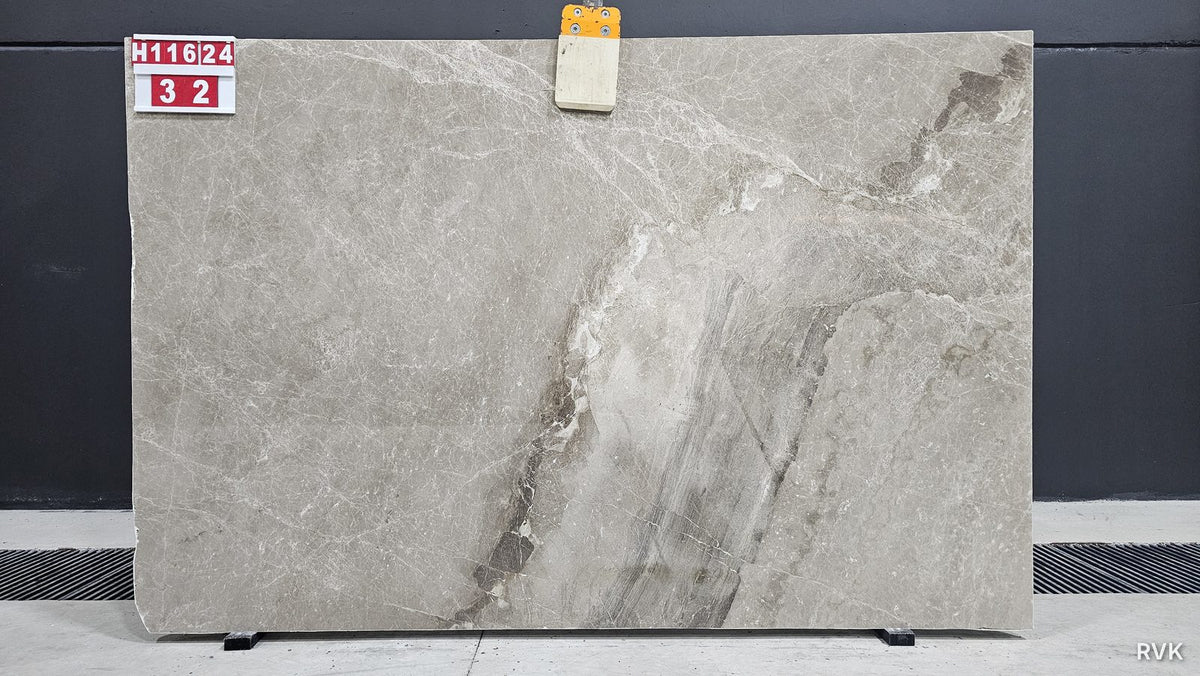
Elsa Grey model, offered polished or honed. On a dining top, the honed finish shows acid marks less.
Thickness, weight and span
| Top | Size | 2 cm (about 54 kg/m²) | 3 cm (about 81 kg/m²) |
|---|---|---|---|
| Side table | 50x50 cm | about 14 kg | about 20 kg |
| Coffee table | 120x60 cm | about 39 kg | about 58 kg |
| Console | 140x40 cm | about 30 kg | about 45 kg |
| Dining table | 200x100 cm | about 108 kg | about 162 kg |
These weights are estimates from calcite density; the actual density of each slab varies a little by model. For a dining table, a 3 cm top gives both appearance and rigidity. A 2 cm top works well on a full-surface steel or timber substrate. Flexural strength is measured by EN 12372, and it depends on the stone's fabric, pores and micro-cracks (Siegesmund and Dürrast, 2014). The risk rises as the span between supports grows, or as the top overhangs the base.
Practical rules: if the span between supports exceeds 120 cm, or the top overhangs the base by more than 30 cm, choose a 3 cm slab or add a full-surface substrate. Breccia and onyx always need a substrate. Carry a top upright, on its long edge, with two people.
Base structure, fixing and load
Stone is sensitive to point loads. A thin top resting on four slim legs can crack under a central load, while the same slab supported around its perimeter carries weight safely. In laboratory tests, a sandwich reinforcement with glass-epoxy faces raised the structural characteristics of stone tiles by up to an order of magnitude (Sorrentino et al., 2018). In furniture, the equivalent is a plywood, MDF, compact laminate or steel substrate bonded beneath the stone.
Do not drill through the stone for fixing. Bond the top to the substrate and screw the substrate to the base. Where metal legs are used, place an elastic adhesive pad or felt between stone and metal. The furniture designer and maker set these details before cutting.
Edge profile and corner detail
- Square arris: the standard finish, clean and modern, with a small chamfer that protects the edge.
- Half or full round (bullnose): classic tables and homes with children.
- Chamfered edge: makes the top look slimmer.
- Mitred laminated edge: a 2 cm slab cut at 45 degrees and bonded to the edge gives a 4 cm or thicker look.
Rounded corners improve safety and reduce edge breakage. Edge profiles are made on request. The profile specification should show the visible thickness and the real load-bearing thickness separately.
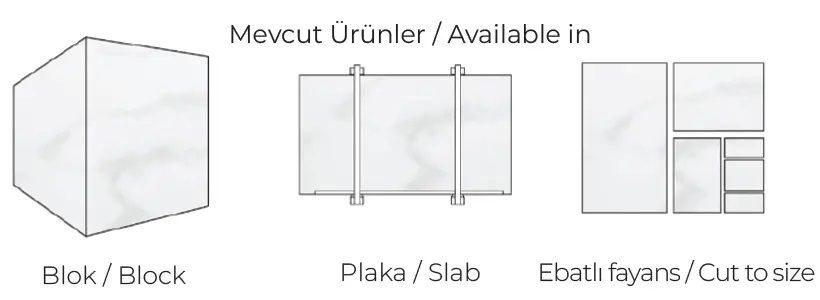
Natural stone is supplied as blocks, slabs or cut-to-size pieces. Table tops are cut to the buyer's dimensions.
Everyday use and care
The Natural Stone Institute recommends a neutral cleaner, coasters and trivets for hot dishes. Acidic drinks leave matt marks on calcareous stone, and gritty dust scratches the surface (NSI). A sealer reduces staining but does not prevent acid etching, and a water-drop test shows when re-sealing is due (Vozza, 2019). On a dining top, a honed surface and a dolomitic stone reduce the care load. A polished top is easier to wipe clean but shows marks more clearly.
Marble, timber and metal together
Light stone with walnut bases gives a warm result. White veined marble with black metal legs gives a contrasting look. Brass and gold metals suit beige and brown stones, while matt black and chrome are common with grey and white stones. Compare the slab photo with the timber and paint swatches under the same light. For hotel and villa projects, see our guide to boutique hotel furniture.
How RVK supplies marble for table tops
Supply starts with slab selection. A block is matched to the colour and vein structure the project needs, then slabs are cut, polished and bundled. The buyer approves each numbered slab from photos, and video is available on request. Approved slabs are crated in ISPM 15 heat-treated wooden crates with padding and steel strapping.
Slab thickness is 2 cm as standard, with 3 cm on request. Slab-based prices range from USD 195 to 650 per m², EXW Türkiye, and quotes are valid for 10 days. Stock is dispatched within a few days of approval, while new cutting takes 3 to 4 weeks plus transit. A deposit is due at order confirmation and the balance is paid by bank transfer after photos or video of the crated slabs are shared and before loading. EXW, FOB, CIF and DDP to Europe are offered.
Conclusion
A marble table top succeeds when three things align: a structure designed for the stone's weight, full-surface support instead of point loads, and a stone and finish chosen for the actual use. A 2 cm slab works on a substrate, a 3 cm slab can stand alone, and breccia and onyx are always supported. Numbered slab approval and a confirmed edge profile come before cutting.
Frequently asked questions
Can a marble table top break easily?
Marble is brittle and has low tensile strength (Sorrentino et al., 2018). A full-surface substrate, perimeter support and the right thickness reduce the risk greatly. Point loads and large overhangs increase it.
Is marble suitable for an everyday dining table?
Yes, with a neutral cleaner, coasters and trivets. Acidic food must be wiped at once (NSI). A honed surface and a dolomitic stone reduce the care load.
Should I choose 2 cm or 3 cm?
A 3 cm slab suits a dining table and wide spans. A 2 cm slab suits coffee tables, consoles and substrate-backed designs, and a mitred strip can give a thick edge look.
Can a marble top be made to a custom size?
Yes. It is cut to the buyer's dimensions and profile. Round, oval and custom shapes must fit within the slab size. Final sizes are confirmed before ordering.
How heavy is a marble dining table top?
A 2 cm slab weighs about 54 kg per m², and a 3 cm slab about 81 kg per m². A 200 by 100 cm top in 3 cm weighs about 162 kg.
Request a marble slab quote for your table top
Send the top dimensions, quantity, thickness, edge finish, preferred model and destination country. Numbered slab photos and a quote follow shortly.
Message us on WhatsApp Send an emailRVK Mobilya Dekorasyon · Kartaltepe Mah. Talat Artemel Sok. No: 2/2 Bakırköy, Istanbul, Turkey · +90 535 230 24 62 · info@rvkmobilya.com
Sources
- Anthony, J.W., Bideaux, R.A., Bladh, K.W., Nichols, M.C. (Eds.) (2005). Handbook of Mineralogy: calcite and dolomite data sheets. Mineralogical Society of America, Chantilly, VA, USA. handbookofmineralogy.org
- Sorrentino, L., Bellini, C., Polini, W., Turchetta, S. (2018). Performance index of natural stones-GFRP hybrid structures. Fracture and Structural Integrity, 12(46), 285-294. DOI: 10.3221/IGF-ESIS.46.26
- CEN (European Committee for Standardization) (2022). EN 12372:2022 Natural stone test methods - Determination of flexural strength under concentrated load. iteh.es
- Siegesmund, S., Dürrast, H. (2014). Physical and Mechanical Properties of Rocks. In: Siegesmund, S., Snethlage, R. (Eds.), Stone in Architecture, Springer, Berlin, Heidelberg, pp. 97-224. DOI: 10.1007/978-3-642-45155-3_3
- Natural Stone Institute (NSI) (n.d.). Learn About Cleaning Products for Natural Stone. naturalstoneinstitute.org
- Vozza, S. (2019). How to Care for Your Marble Countertops. Use Natural Stone (official campaign of the Natural Stone Institute). usenaturalstone.org