
Book-Matched Marble Slabs: Selection, Numbered Photos, Approval and Shipping from Turkey
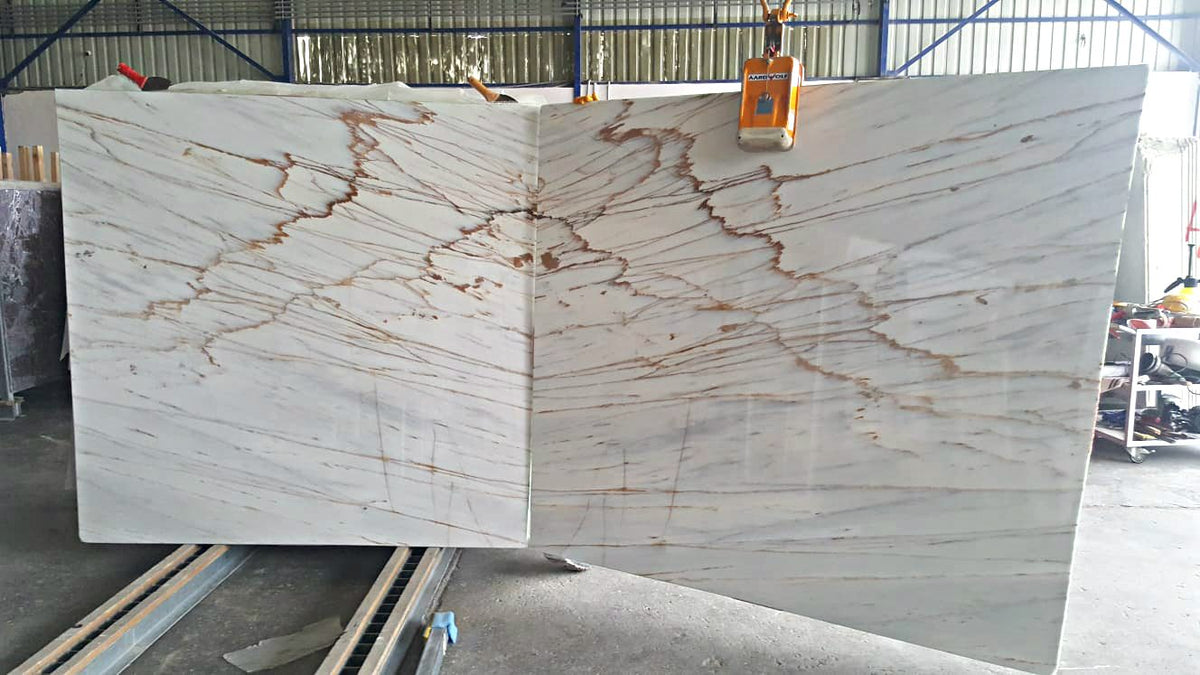
A book-matched pair of Calacatta Gold type slabs, with the veins mirrored at the joint.
Short answer. Book-matched marble means consecutive slabs from the same block, polished on opposite faces so the veins mirror at the joint, like the pages of an open book. Only consecutive slabs can match, so approve the actual slabs, not a catalogue photo. RVK Mobilya Dekorasyon supplies Calacatta, Turkish white, black and grey marbles, travertine and onyx in 2 or 3 cm slabs, with selection and cut-to-size work done in Turkey under RVK's own production management and quality control. Every slab is numbered and photographed, you approve the match from photos before crating, and a slab you did not approve is not loaded. Prices are EXW Istanbul; payment is 40% with the order and 60% before shipment, or 100% in advance for imported stock slabs. We shipped 20 Calacatta Gold slabs to Los Angeles for kitchen countertops.
Author: Volkan Kıyan, owner of RVK Mobilya Dekorasyon, Istanbul. Last updated: 13 October 2026.
| Stones | Italian Calacatta Oro from Istanbul stock, Turkish Calacatta-type stone, Marmara, Afyon and Muğla whites, Toros Black, grey marbles, Denizli travertine, Anatolian onyx |
|---|---|
| Slabs | 250-320 x 140-200 cm, 2 or 3 cm thick; polished, honed, brushed (leather), sandblasted, bush-hammered or split-face |
| Approval | Every slab numbered and photographed; matches approved from photos before shipment; unapproved slabs are not loaded |
| Minimum | One bundle of marble or travertine (6-8 slabs, about 35-50 m²); mixed containers accepted |
| Lead time | Stock slabs 7-15 working days including crating; quarry selection and processing 20-40; cut-to-size projects 30-45 working days |
| Delivery | EXW Istanbul (Incoterms 2020); containers overseas, road within Europe; DDP freight quote on request |
| Payment | 40% with the order, 60% before shipment; imported stock slabs 100% in advance |
Message us on WhatsApp Send us an email
What book-matched marble is: book-match, quad-match and slip-match
Marble is quarried in blocks, and each block is sawn into slabs in sequence, so neighbouring slabs carry almost the same veins. To book-match, two consecutive slabs are polished on opposite faces, the faces that sat together in the block, and laid side by side like the pages of a book.
- Book-match: two consecutive slabs mirrored at one joint, for feature walls, bathroom walls, fireplace surrounds and waterfall islands.
- Quad-match: four consecutive slabs mirrored left to right and top to bottom, with the veins meeting at a centre point, for tall walls, floors and large panels.
- Slip-match (sequential): consecutive slabs laid side by side without flipping, so the pattern repeats instead of mirroring, for long walls and floors.
The rule behind all three: only consecutive slabs from the same block can match. Slabs of the same stone from different blocks will not line up at the joint.
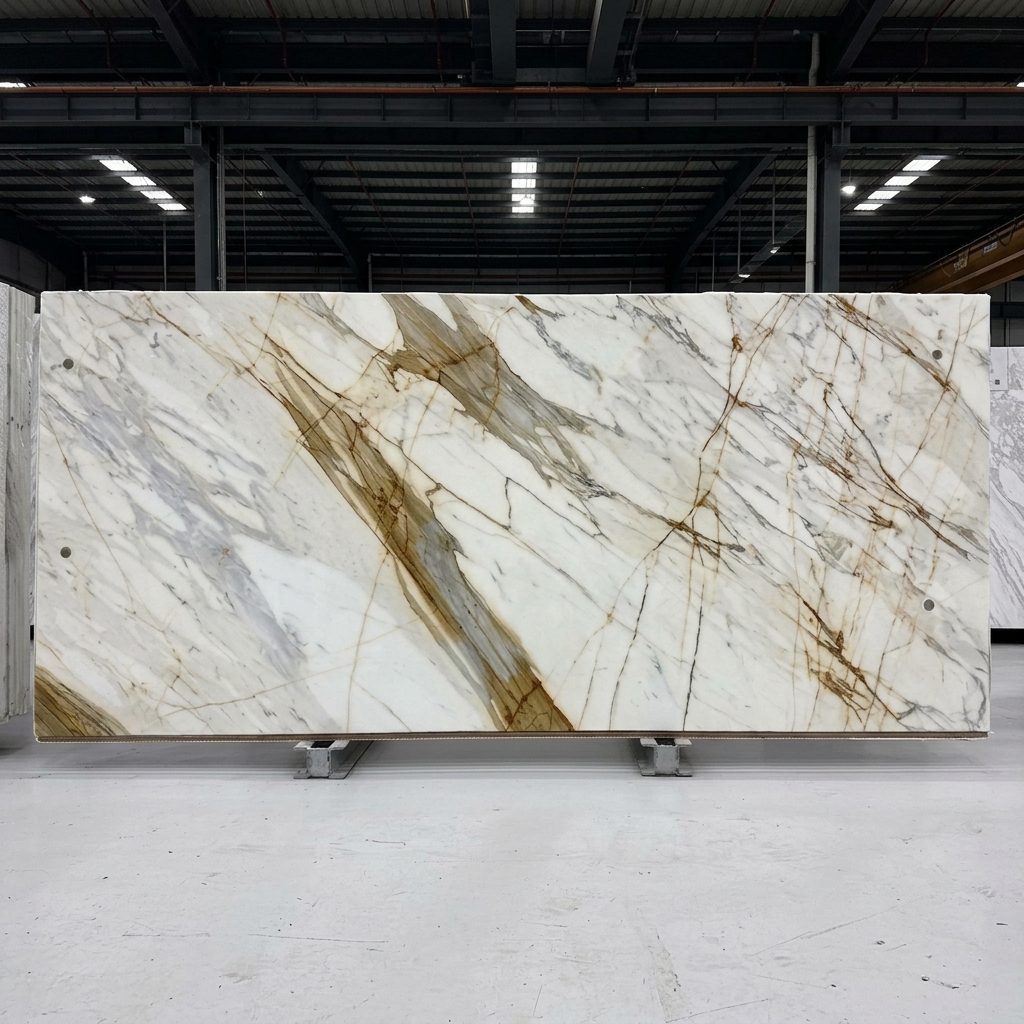
A book-matched series of Calacatta Oro slabs from Istanbul stock.
Why a match needs selection, not a catalogue photo
No two marble slabs are identical: tone and veining change from block to block, and within one block. Sorting slabs has traditionally been visual work. Martínez-Alajarín et al. (2005) note that the marble industry classifies slabs into quality groups manually; they built an automated system that analyses the colour texture of slab surfaces and reported a 98.9% success rate.
For a buyer, this means a stone name and a catalogue photo are not enough. Approve the actual numbered slabs, and check the background tone, the main veins and where the joint will fall.
How slabs are selected, numbered and approved
The process is built so that the slabs you receive are the slabs you approved.
- Block selection: for quarry selection orders, blocks are selected at the quarry.
- Slab selection: slabs are selected at the processing plant; Italian Calacatta Oro is selected from stock in Istanbul.
- Numbering: every slab is numbered and photographed, so each photo shows one physical slab.
- Approval: you approve the slabs by number; book-matched and quad-matched sets are approved from photos before shipment.
- Loading: a slab you did not approve is not loaded.
- Cut-to-size work: pieces are dry-laid, numbered and photographed before packing.
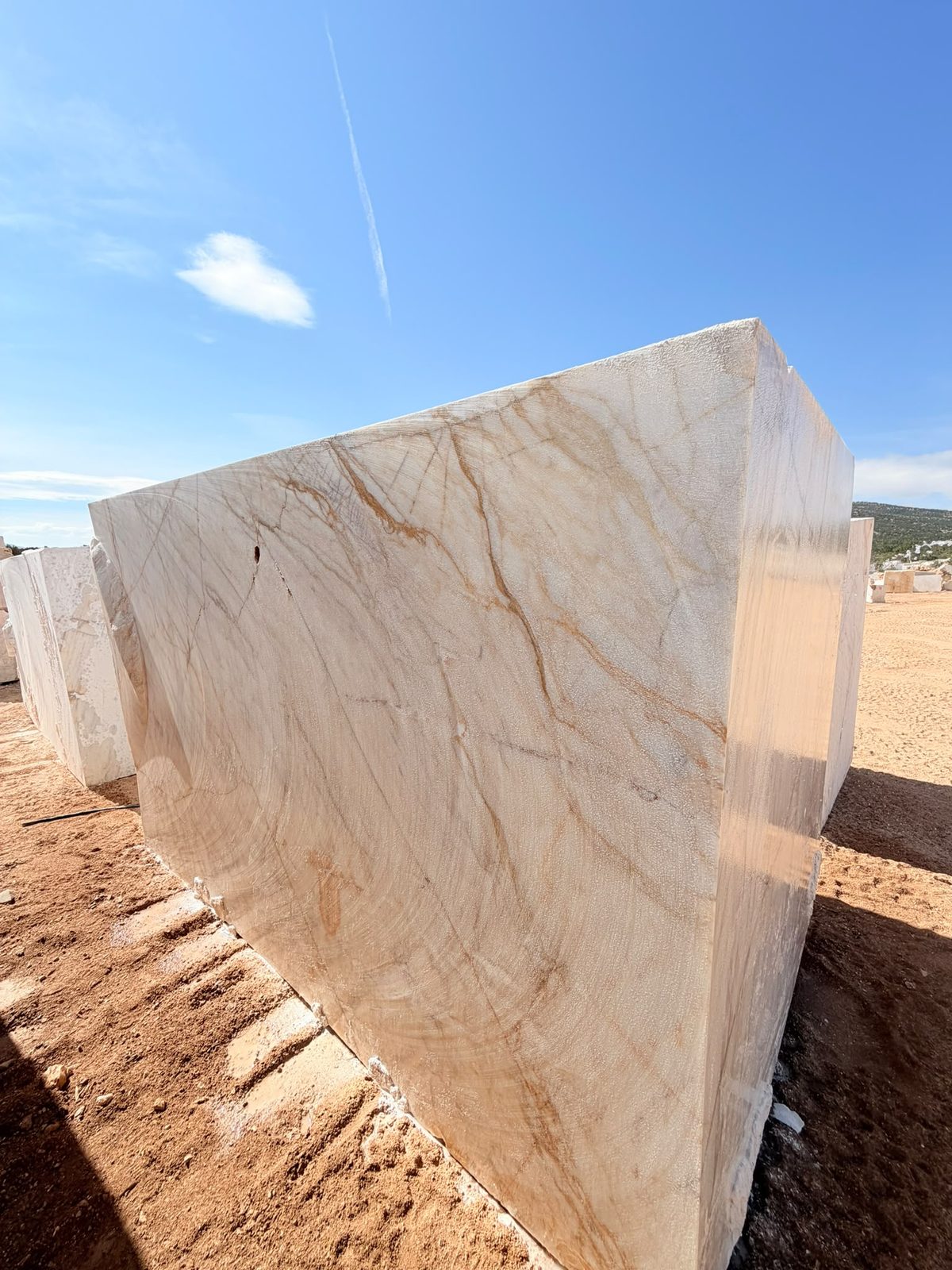
Block selection at a quarry in Turkey. The slabs of one match must come from one block.
Specifying Calacatta and other marble slabs: size, thickness and finish
Slabs are 250-320 cm long and 140-200 cm wide (about 98-126 by 55-79 in), and 2 cm (approx. 3/4 in) or 3 cm (approx. 1 1/4 in) thick. Finishes are polished (gloss, the veins read most strongly), honed (matt, hides etch marks better), brushed (leather), and the rougher sandblasted, bush-hammered and split-face textures.
When buyers ask for Calacatta marble slabs from Turkey, two products are involved. Calacatta Oro is an Italian marble that we supply from stock in Istanbul. Turkish Calacatta-type stone is a different, Turkish stone, quoted under its own name. The range also covers Marmara, Afyon and Muğla whites, Toros Black, grey marbles, Denizli travertine and Anatolian onyx, with quartz and sintered slabs as alternatives. The full range is on our marble, porcelain and sintered stone slabs page.
Planning a bookmatch marble wall or island: how many slabs
Your designer or fabricator plans the layout; we do not prepare layout drawings. The method:
- Measure the wall, or the island top, ends and splashback.
- Compare with the usable slab area: a slab is at most 320 cm long and 200 cm wide, and its edges are trimmed before cutting.
- Fix the joint, usually on the centre line of the wall or of a fireplace or bath.
- Count the slabs per match: two per mirrored pair for a book-match, four for a quad-match; a wall taller than one slab needs a horizontal joint.
- For a waterfall island, cut the top and the end panels from the same or consecutive slabs, so that the veins run over the edge.
Send us the dimensions, the joint position and the match type; we reply with numbered photos of slabs that fit and an itemised proforma. Worktops for a kitchen we make can be supplied in the same order: see our kitchen cabinets page.
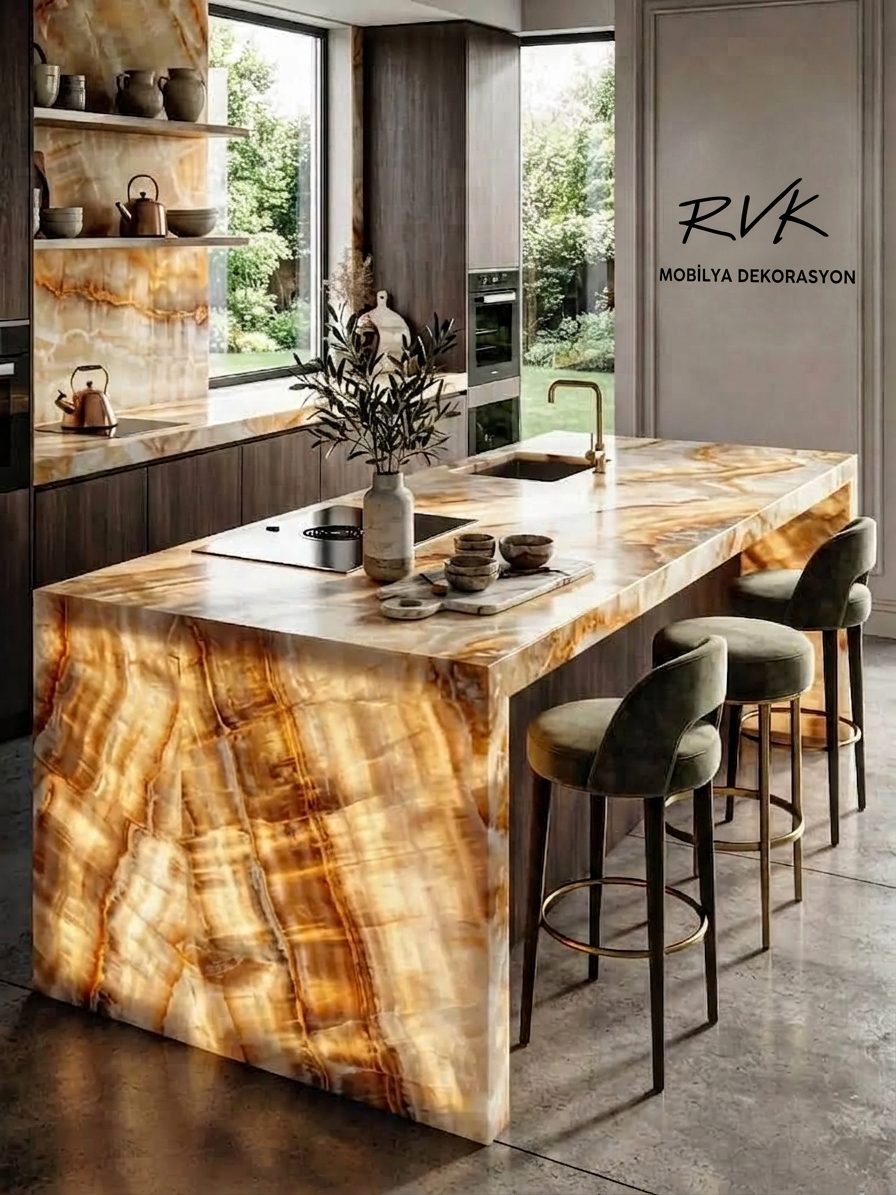
Honey onyx kitchen island with a waterfall top and splashback, a real stone application.
Marble care and limits: acids, finishes and outdoor use
Marble is a carbonate stone, and acids attack carbonate stone. Field experiments in the US National Acid Precipitation Assessment Program showed that acidic deposition contributes to the erosion of carbonate stone such as marble (Baedecker et al., 1992). That research concerns stone exposed outdoors, not kitchens. Indoors, practical experience shows that lemon juice, vinegar and acidic cleaners leave dull marks, known as etching, on polished marble.
- Wipe acidic spills quickly and clean with a pH-neutral cleaner.
- A sealer helps against stains, but it does not make marble acid-proof.
- On kitchen tops, honed hides etch marks better than polished; for heavy use, quartz, porcelain or sintered slabs are alternatives.
Outdoors, the calcite grains in marble expand by different amounts in different directions as the temperature changes, and this anisotropic thermal expansion can weather marble physically (Siegesmund et al., 2000). For exterior surfaces, choose the stone and its thickness with care, together with your architect or engineer.
Packing and shipping
Slabs travel in ISPM 15 wooden A-frames or closed crates, with foam and cardboard between them. A 20' container takes about 350-400 m² of 2 cm slabs (roughly 3,770-4,300 sq ft), or 20-25 tonnes; with 3 cm slabs, the same weight covers a smaller area.
Prices are EXW Istanbul (Incoterms 2020). Overseas, slabs go by 20' or 40' container; within Europe, by road in 4-7 days (Germany 5-8, London about a week). We prepare a door-to-door (DDP) freight quote on request and issue the commercial invoice, packing list and A.TR (EU), EUR.1 or certificate of origin, depending on the destination. Worked natural stone falls under HS 6802, and Turkish VAT is not charged on export sales.
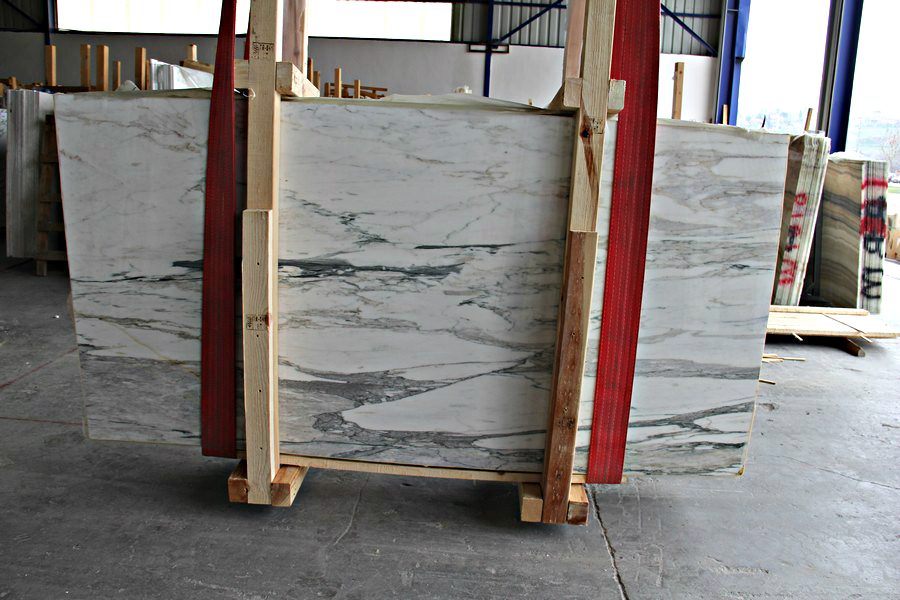
Arabescato type slabs in a wooden A-frame. For export, A-frames and crates are ISPM 15 stamped.
Minimum order, lead times and payment
- Minimum: one bundle of marble or travertine (6-8 slabs, about 35-50 m²); mixed containers are accepted.
- Lead time (working days): stock slabs 7-15 including crating, quarry selection and processing 20-40, cut-to-size projects 30-45, counted from the deposit and your slab approval.
- Payment: 40% with the order and 60% before shipment, by bank transfer in USD, EUR, GBP or TRY; imported stock slabs 100% in advance. We do not work with letters of credit.
- Installation: not offered. Pieces are cut to size from your template, and your fitter installs them.
Real projects
- Los Angeles, USA: 20 Calacatta Gold marble slabs for kitchen countertops.
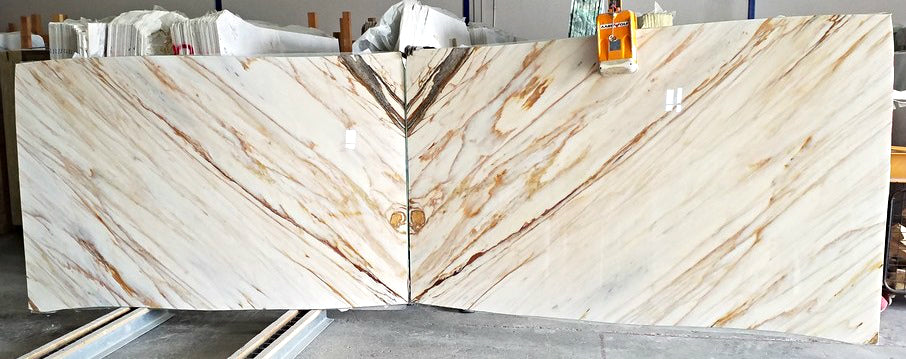
Los Angeles: Calacatta Gold slabs for kitchen countertops. Photo from our own shipment.
We have delivered projects in 9 countries outside Turkey; all of them are on our Projects page.
What to send for a quotation
- The stone (name or photo) and the finish
- Where it goes: feature wall, bathroom, waterfall island, floor or fireplace
- Wall or island dimensions, or your designer's drawings, with the joint position
- Match type (book-match, quad-match or slip-match) and thickness (2 or 3 cm)
- Full slabs or cut-to-size pieces; for cut-to-size work, your template
- Delivery address or port, and your target date
Request a quotation
Send the stone you want, the wall or island dimensions and your target thickness; we reply with numbered slab photos and an itemised proforma within 1-2 working days.
Message us on WhatsApp Send us an email
WhatsApp: +90 535 230 24 62 | Email: info@rvkmobilya.com
Frequently asked questions
How many slabs do I need for a book-matched wall?
It depends on the wall size and the slab size: two consecutive slabs per mirrored pair, four for a quad-match. Send the dimensions; the proforma lists the number of slabs.
Can I approve the exact slabs before shipment?
Yes. Every slab is numbered and photographed, and you approve the slabs and matched sets from the photos before crating. A slab you did not approve is not loaded.
Should I choose 2 cm or 3 cm slabs?
Both are available. 2 cm (approx. 3/4 in) is lighter and suits wall cladding; 3 cm (approx. 1 1/4 in) gives a thicker edge on worktops and waterfall islands but weighs 50% more. Your fabricator confirms the choice.
Polished or honed for a kitchen?
Honed hides acid etch marks better; polished shows the veins most strongly, but etching shows on it too. For heavy use, quartz, porcelain or sintered slabs are alternatives.
Do you ship to the United States?
Yes. Prices are EXW Istanbul, slabs travel by 20' or 40' container, and we prepare a DDP freight quote on request. We shipped 20 Calacatta Gold slabs to Los Angeles for kitchen countertops.
Do you install the stone?
No. Pieces are cut to size from your template, and your own fitter installs them.
How is stock Calacatta Oro paid?
Imported stock slabs, such as Calacatta Oro from Istanbul stock, are paid 100% in advance. Other orders are paid 40% with the order and 60% before shipment.
Sources
- Baedecker, P. A., Reddy, M. M., Reimann, K. J., & Sciammarella, C. A. (1992). Effects of acidic deposition on the erosion of carbonate stone: Experimental results from the U.S. National Acid Precipitation Assessment Program (NAPAP). Atmospheric Environment. Part B, Urban Atmosphere, 26(2), 147-158. doi:10.1016/0957-1272(92)90018-N
- Martínez-Alajarín, J., Luis-Delgado, J. D., & Tomás-Balibrea, L. M. (2005). Automatic system for quality-based classification of marble textures. IEEE Transactions on Systems, Man, and Cybernetics, Part C (Applications and Reviews), 35(4), 488-497. doi:10.1109/TSMCC.2004.843236
- Siegesmund, S., Ullemeyer, K., Weiss, T., & Tschegg, E. K. (2000). Physical weathering of marbles caused by anisotropic thermal expansion. International Journal of Earth Sciences, 89(1), 170-182. doi:10.1007/s005310050324